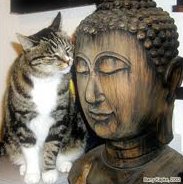
Let no one deceive another or despise anyone anywhere, or through anger or resistance wish for another to suffer.

10 July 2012

Worry makes the world go "Owww!"


Everyone experiences worry to some extent. For some, worry can seem vast and all-encompassing. It seems to envelop the entire mind, tying it up in tightly binding knots. In the body, worry can turn up as sweating, shaking, headaches, dry mouth, irritable bowels, restlessness, tiredness and insomnia. The list seems endless. Now science has provided a look into exactly what is going on inside the brain during these events, and it is a lot less daunting than we usually think.
 

Studies using MRI scans show worry is really only taking place in two small areas of the brain. These areas, (the medial pre-frontal cortex and the anterior cingulate cortex), are known to be involved in mentalisation and introspection.

A lot of thinking about thinking goes on in these regions. Under stress, these areas light up, not only because there may be something to worry about, but also because we think about and dwell on the worry, using those two areas of the brain to process what it means to us now, what it could mean in the future, or to make comparisons with what something like it has meant in the past.

It is important to notice that the studies show that those who worry a little, and those who worry a lot, have essentially the same kind of activity going on inside the brain. Worry lights up the same areas in everyone. The difference is that, for some, the lights stay on long after the stimulus for the worry has passed.

This extra activity – worrying about worry - is exactly like turning a light switch on and off a thousand times when once would do. For those who worry, the real world scenarios are all too familiar, such as patting your pocket to make sure if you still have your keys or phone, or checking and rechecking phone messages for that call that never seems to come. Even more worrisome is repeated mental revising and rehearsal of scenarios long gone, or that will never come.

In the terms of the researchers, over-persistent activity in these two small areas of the brain involved with worry is called “dysregulation,” meaning there is a kind of free-for-all of repetitive and speculative activity going on in these areas, overloading the circuitry and leading to other effects elsewhere in the mind and body.

This is how a perfectly routine action, such as being concerned about something, can turn into a set of feelings and sensations that seem so vast and enveloping they become a smothering blanket of tension and stress, often turning up as physical symptoms.

What is happening is that all that extra mental activity makes us restless, we become exhausted, and often experience an acute sense of doubt and disillusion. Every slight twinge or pain then becomes a proof of why we were worried in the first place, so a kind of feed-back loop takes over and the physical burden becomes an extra reason to continue worrying.

As overwhelming as these effects may be, the new research shows that the worry we may have experienced is actually rather small and limited in its origin. Knowledge of where its painful effects originate, means we can potentially target those areas, rather than trying to deal with “the mind” as a whole.

None of this is new to those who practice with dhamma. It says something about the penetrative aspects of meditation and the efficacy of the techniques taught by the Buddha that all of the states of mind revealed by the latest medical technologies are exactly as described in the texts on the mind that are at least two thousand years old.

This doesn't mean that the debilitating effects are exaggerated or should be dismissed as unimportant. Quite the opposite. However, it is possible to accept that small victories can win a larger battle. A good suggestion may be to introduce some skilful means and helpful controls to these mind areas that would help lessen the debilitating effect of worry.

What is essential is to understand the transient nature of events:

“Nothing caused can be permanent, for there are no permanent causes. Any happiness [or unhappiness] based on impermanent causes will have to be impermanent as well. When a cause passes away, its effect will—either immediately or over time—pass away, too.

Suffering is not caused primarily by unpleasant sensory contact; it is caused by the attitudes and views that are brought to any sensory contact, pleasant or not. This further means that the crucial causes for stress and suffering are internal, and thus not dependent on outside circumstances. They are subject to one’s knowledge and will. In this way, the quest for the end of suffering is primarily an internal matter of training the mind.”- Thanissaro

I hope most can agree that when worry strikes it often takes the form of little flutters of regret and feeling sorry for ourselves. Self-pity is such a common human illness. It must be abandoned!
Here is the prescription for curing the worry of self-pity.

First, repeat these statements aloud until feeling better:
  1. The past I feel sorry about was not actually like that.
  2. The past cannot be dug up and resurrected. (We cannot wake the dead moments, only disturb their graves.)
  3. The person I feel sorry for is not what I think he/she is.
  4. The future will be what I make it NOW!

Second, let go and trust!
  1. Breathe out slowly. Think "softening." Hold for a count of five to let the energy gather.
  2. Breathe in calmly. Think "brightening." See how far the energy travels inside. A little way? A little bright? Hold for a count of five to let the energy spread throughout the body.
  3. Fill the body with the breath. Picture the breath as one of those big sausage balloons. Breathing in, think: “beginning of the breath, middle of the breath, end of the breath.” Breathing out, think:“beginning of the breath, middle of the breath, end of the breath.”
  4. Breathe and smile. Enjoy the calm and peaceful rhythm of the breath. Repeat steps 1 to 4 for at least ten minutes. This can be done anywhere. When worry arises, try it, even if only for a few breaths. It will help.

Giving careful attention to the breath in this way is classed as a feeling among other feelings. The mind can only maintain one feeling at a time! Feeling the breath trumps feelings of worry or self-pity.

Of course you may find yourself struggling in the mind with newly arisen feelings of worrying and feeling sorry for yourself. Maybe you start feeling that you don't have time to do this, or worrying that you are not doing it correctly.

First, this is kind of absurd, as we breath around 26,500 times per day, so you have had plenty of practice already. Second, noticing that you are worrying and doubting is mindfulness in action.

Noticing that these feelings are caused – that they are arising and passing away – gives us a clue about the transient nature of events. This begins to be the basis for a new attitude and view of the way things are in the mind. We are not stuck with old habits. They can change in just one breath. With this small exercise we win a major victory in training the mind.

Finally, if you who worry are good at doing things repetitively, you may quickly become very good at taking up and continuing this new habit of paying attention to the breath.

You can never overdo attentive mindfulness!

Breathe and smile. Repeat until your last breath. (Hopefully not soon.)

12 June 2012

Come and see.

“This [dhamma] will be for your happiness; for your well-being,” the Tathagata said. 

Pondering on what this one or that one has said is following a defilement like a child following a poisonous snake. Despite this truth, I will say something. 

Kamma is central to discernment of dhamma. Kamma is action. Dhamma is kamma made effective. 

Here, in a few words, is how to produce the right kammic action, and therefore the right dhamma effect: 

“Breathe and smile. Soften, don't resist. Be silent. Meditate now.” 

 These words are the mantra of dhamma. This method is an effective way to end the tyranny of "emotions," which we know as craving, clinging and suffering. 

Breathing and smiling I get. I get softening. I am aware of the need to resist. I am unsure of what it means to be silent. But why meditate?

We meditate to end craving, clinging and suffering. 

What is craving?

Craving is getting involved in liking and disliking whatever arises in the present moment.

What is clinging?

Clinging is dwelling on involvement in liking and disliking whatever arises in the present moment.

Central to this process of liking and disliking is a chain of arising. “From this comes that.” 

This is kamma as action. Within this chain of arising, with the right conditions, from craving comes clinging, from clinging comes becoming. 

What is becoming?

We become what we dwell on. If we crave and cling, this is what we become. From becoming what we dwell on, we are born, or “borne,”carried, transported, into this very moment, as suffering beings, infected with craving and clinging. We endlessly repeat this cycle, moment to moment, hence we continue to suffer in perpetuity.

What is suffering?

Suffering (stress, unpleasantness, discomfort, the unbearable burden, the contemptible void, or dukkha in Pali), is being associated with what we don't like.

Suffering is being disassociated from what we like.

Suffering is not getting what we want.

We often imagine what we like, what we dislike, what we want, are “out there” somewhere.

Suffering is not elsewhere. It is right here in what we are clinging onto, right now.

In the experience of body, the feelings, the perceptions, the conditioned actions, the thoughts, we are entangled in a clinging, craving, suffering mess that goes on endlessly.

To end this craving and clinging and suffering, we must breathe and smile. Soften, don't resist. Meditate now. 

Once we see for ourselves, we can release ourselves. Come and see. Don't speculate. Find a teacher. Don't worry which teacher. The one you find will be due to your kamma, not your choice!

Follow the instructions. The first instruction of any worthy teacher is to be silent. Stop pondering. Only this good wholesome kamma action (remember, kamma is action) of inner silence will release you from misery. Once you are silent, you will become happy. This is possible. Reassure yourself. This way is the only way. It is your way. It doesn't belong to Buddha, gods, or gurus. It is your inheritance and your good fortune. Enjoy!


15 January 2011

New podcast page

"To be respectful, humble, contented and grateful; and to listen to the Dhamma on due occasions — this is the greatest blessing." - Mangala Sutta.
  
New to this blog is a page where you can listen to or download podcasts of meditation and dhamma talks. The first is a guided breath meditation that will be of use to those who want to think more about the way the breath features in meditation. More podcasts will be added as I produce them. The technology now available to record, reproduce and distribute audio in this way is a wonderful thing, especially when used for a worthwhile purpose. May this new page be proven worthy. Please leave a comment about possible podcast themes or topics.

05 December 2010

Bodily acts

"Therefore, Rahula, you should train yourself: 'I will purify my bodily acts through repeated reflection. I will purify my verbal acts through repeated reflection. I will purify my mental acts through repeated reflection.' That is how you should train yourself."
— MN 61
When I first went into a Buddhist meditation hall, I was struck by the presence of the Buddha image. It seemed larger than life and I had an immediate sense of panic. I noticed others bowing and felt uncomfortable and a little caught out by the ritualised nature of these actions. My precious personality was on show. I was full of half baked ideas and un-arisen fears. I realised I needed to work hard to overcome this ego-driven rigidity.

In Jack Kornfield's excellent book Living Buddhist Masters, Thai meditation master Ajahn Chah makes a very strong point about the reasons why bowing occurs in Buddhism. Bowing is a good remedy for conceit and pride. By bowing there is recognition of Buddha, Dhamma and Sangha. In mind this is a recognition of the qualities of purity, radiance and peace. The outer action trains the interior state. The mind and body are brought into harmony. The mind is rigid when resisting the simple gesture of bowing. Bowing is a sign of internal ease. Becoming harmonious means moving beyond exterior form. What Ajahn Chah means is we can seek through a simple gesture to get beyond selfishness, beyond opinion, beyond a sense of entitlement, of exemption from the nature of the world.

Language traps us into concepts of difference, of discrimination, such as size, importance, race, religion, pretty, ugly, black, white, north, south, east, west. These language concepts are created from craving, they arise in response to craving. Craving arises from ignorance. This is so all along the chain of dependent origination. The formula runs “from this comes that,” but in truth it means “from this comes this:” no distinction is involved.

Along the Noble Eightfold Path, the simple act of bowing connects the mind to Right Resolve (Samma sankappo):

"And what is right resolve? Being resolved on renunciation, on freedom from ill-will, on harmlessness: This is called right resolve."
To bow, in the Buddhist context, is therefore not to grovel before an idol or a god. It does not mean blind obedience to an ideology or a teaching. It means instead a willingness to examine the greed, ill-will and clouded thinking that has arisen, or remains un-arisen, in order to favour the arising of renunciation of what is harmful; filling the heart instead with kindness, compassion, sympathetic joy, in place of animosity, pride, jealousy, infatuation, or worry; clearing the mind of ignorance, in expectation of the arising of equanimity and wisdom.

Top image link. Lower image link.


04 December 2010

Freed from crooked things-a revision

Tucked away in the Tipitaka, in the esoteric Khuddaka Nikaya, is an extraordinary collection of 264 short poems in 1,291 stanzas called the Theragatha. The many and varied voices of the monks who extemporised these free flowing verses over two thousand years ago are a revealing testament of the Buddha's mission in action. Selected over time to be included in the Tipitaka, no doubt for their emphasis on practice and persistence, and as a testimonial to the efficacy of the way of the Tathagata, the verses speak of a thriving and open intellectual environment, more or less free of hierarchical domination. It is hard to find anything similar anywhere else in the history of thought. It is true to say that there are no critical voices included among the verses (if there were any to begin with, which is a sceptical position with no basis), or nothing that could at least be called a critique of the philosophy underlying the practice and austerity the creators of the stanzas are undertaking. This does not make them propaganda. The authors many times reveal their own weaknesses and struggles. A party line would have them all saying bland things in formulaic ways about Dhamma and the Blessed One. They would all at least make great claims for their own abilities. This is far from the case. The modesty and self-effacement of such presumably senior monks is striking. This humility, expressed in such a variety of voices, combined with the relative strengths and weaknesses of their verse-making, and the many varied stages of both intellectual development and meditation prowess on display in the verses, is what makes them so compelling as historical figures.

(It is to my personal shame that when I wrote this article I was not aware of the companion verses of the woman of the early sangha, the bhikkhunis, to be found in the 73 poems - 522 stanzas in all - of the Therigatha. Here is further primary evidence, definable proof, of the revolutionary, transformational and egalitarian nature of the Buddha's Dhamma and its impact on dominant social structures:
"So freed! So freed! So thoroughly freed am I — from my pestle, my shameless husband & his sun-shade making, my mouldy old pot with its water-snake smell. Aversion & passion I cut with a chop. Having come to the foot of a tree, I meditate, absorbed in the bliss: 'What bliss!'"-Sumangala's Mother. (Thig 2).
Never before and hardly since, in religion or philosophy, even into the twentieth century, have the true and candid voices of women been heard, so freely expressed and without the restrictions or moderation of a manipulative patriarchal hierarchy. For a thorough exploration of these truly inspiring feminist voices, read Vijitha Rajapakse, The Therigatha: A Revaluation. Whatever small merit that may accumulate in revising this article to include the voices of the ancient elder women, can only be dedicated to all women, particularly those contemporary Bhikkhunis who continue to struggle to be heard and recognised as equal companions on the Noble Path.)

It is a cliché to say that the voice of history tends to be that of kings, priests, prophets and the powerful. To balance this, historians always look for the voices of the real, the asides made in the wings of the great play of events, as a way into the minds, not of the great, but of the everyday person. These candid, informal voices are rare, hence their immense value. In this context the verses of the Theragatha and the Therigatha are invaluable insights into actual Buddhist praxis in the lifetime of the Tathagata in all its gritty reality.

The verses are, more often than not, witness statements to the daily grind of going forth with dhamma. It is if each contributor has been tapped on the shoulder by an interviewer and asked to give a quick appraisal of how they are getting along, how they are finding things so far, what they do to keep themselves going, what advice they follow, or what advice they might have for others. The verses, viewed this way, are less like poetry and more like the often-found poetics, so to speak, of statements taken verbatim from the field.

“Outside of this path,
the path of the many who teach other things doesn't go to Unbinding as does this:
Thus the Blessed One instructs the Community,
truly showing the palms of his hands.”
- Nagita (Thag. 1.86).

The often cheerful, sometimes slightly clumsy spontaneity of the verse is perhaps the most enduring, charming, singular aspect of the Theragatha and Therigatha. This can often produce imagery and sentiments of concise beauty and precision.

“The earth is sprinkled with rain,
wind is blowing,
lightning wanders the sky,
but my thoughts are stilled,
well-centered is my mind.”
- Vimala (Thag. 1.50).
“Even with all the whistles & whistling,
the calls of the birds,
my mind doesn't waver,
for my delight is in oneness.”
- Ramaneyakka (Thag. 1.49).

The casual, informal quality of many of the stanzas does not make them any the less powerful as verse, or any less persuasive as evidence of the personality of the Bhikkhu or Bhikkuni, glimpsed between the lines, struggling with his or her task.

“Going forth is hard;
houses are hard places to live;
the Dhamma is deep;
wealth, hard to obtain;
it's hard to keep going with whatever we get:
so it's right that we ponder continually
continual inconstancy.”
- Jenta (Thag. 1.111).

“So freed!
So freed!
So thoroughly freed am I from three crooked things:
my sickles,
my shovels,
my ploughs.
Even if they were here,
right here,
I'd be done with them,
done with them.
Do jhana, Sumangala.
Sumangala, stay heedful.”
- Sumangala (Thag. 1.43).

It is difficult to establish exactly how these verses came to be compiled, for what precise reason, and over what period of time they were drawn together. That they were mainly gathered together in the time of the Buddha is beyond dispute. Rahula, the Buddha's son, contributes two verses. Contributing Bhikkhus, such as Vangisa, the nominal poet-laureate of the early Sangha, appear in separate suttas and feature in post-canonical works. If the dates of the other suttas are in dispute then the whole chronology of the canon falls apart.

As to the purpose and role of these verses, it must be seen that poetic expression, although not stated explicitly, was considered part of Right Speech.
"Monks, a statement endowed with five factors is well-spoken, not ill-spoken. It is blameless & unfaulted by knowledgeable people. Which five?
"It is spoken at the right time. It is spoken in truth. It is spoken affectionately. It is spoken beneficially. It is spoken with a mind of good-will."
The Buddha himself breaks into spontaneous verse on numerous occasions. For the nature and purpose of Buddhist poetics to be better understood, it is worthwhile looking particularly in the Udana sutta. In case there is doubt about the voice heard in the suttas, whether it is really the Buddha speaking, or some later summation of his message, at least it can be said that there is in the design of the suttas, a form which gives the discourse, first as expansionary prose and then summed up in verse. This indicates that poetic imagery made up a significant part of the aesthetic sensibility, the common cultural expression, of all classes, known to householders and Brahmans, regardless of status. Buddhism may be many things, but it is never elitist. Indeed, egalitarian equality, a common touch, a readily understandable teaching, are at the heart of its ethos. Therefore, this versification can't be seen as some form of literary convention, applied to the suttas when they were written down, as some way of summarising the meaning within the text as it began to appear on the palm leaf pages, but instead it must be affirmed that spontaneous, spoken verse arose at the time of the creation of the discourses, as both a means of emphasising the point of the sutta and as a method of mnemonic reinforcement.

It is not the case that this verse form was a Buddhist invention. The courts and assemblies of various princes and kings, even rich merchants, no doubt found a home for poets. This sensibility spilled out into all levels of society. But in particular, verse making was a popular activity for the young and well-heeled, many of whom became attracted to the Buddha's message, as Vangisa himself reveals:
"Intoxicated with skill in the poetic art, formerly we wandered from village to village, from town to town. Then we saw the Awakened One and faith arose in us." - Va"ngiisa (1&2).
The epic and colloquial poetic tradition in India is a rich one. Knowledge of the Buddhist contribution to this form of expression is limited within the academic world, and sadly among Indians generally, due to the dominance of the Vedic/Hindu tradition following the diffusion and the sometimes violent dissolution of Buddhism within India from the 7th and 8th centuries of the common era onwards. The texts themselves persist, however, and the small voices of the monks of the early Sangha can still be heard, and may still inspire.

"Knowing what comes first and last, Knowing well the meaning, too, Skilful in grammar and in other items, The well-grasped meaning is examined.  
Keen in patient application, strive to weigh the meaning well. At the right time make the effort, And inwardly collect the mind." - Ananda (1028-1029), Thag. 17.3.

Top image: Studying suttas, Inle Lake, Burma. Lower image: Alms round, Laos.

11 November 2010

This is Buddhism

What is a Buddhist? A Buddhist is someone who seeks to show unconditional loving kindness, personally, to every being everywhere, in such a way that this is not noticed, yet it is clearly understood and gratefully received, without the need for any return. This is surely unattainable, impossible. But this is what we should do! Even though it is impossible, our true nature says we could do it, so we try. This is Buddhism. However, this is not idealism, being kind for the sake of others; or being merely positive for the sake of self-interest, for looking good, for impressing anyone. That is easy. That is not Buddhism. So doing what is merely possible is not the dhamma way. Yet, doing what is impossible is also not the dhamma way. Little by little is the dhamma way. The effort made. Now. Now. Now. That is the way. 
Anyone who has been lucky enough to experience a Vipassana retreat will smile when I say: “Start again! Start again!” For all others to understand, these are the words Goenkaji uses to introduce many meditation sessions. These words echo around in the mind,during and after a retreat, like a Vipassana mantra, at times even more vividly than the Pali chants. 
What does it mean? Start what again? Meditation, yes. But meditation is the possible. Sit, watch the breath, watch sensations. Be silent for ten days. This is easy. 
More to the point of what-a-Buddhist-is, is making the effort to “start again.” This is hard, but not impossible. What is impossible, is that once the effort is made, it will fail. Before there is a “start again,” there is doubt. Once you “start again,” there is none. The effort is the effect. The attempt is the outcome. All of this is sounding very Zen. This word “Zen” has come to mean enigmatic, contradictory. Put it aside. Put aside Vipassana. Put aside Dhamma. Put aside Buddhist. 
The true human heart is like a leaf on a still day. It is unstirred by wind, by events. Yet when the wind blows, when there is tension, turbulence and agitation, the leaf trembles and bends. When it rains the leaf becomes soaked, when the sun shines, the leaf dries out. When all that turbulence ceases, the leaf again becomes still. 

If, to be a Buddhist, means to be kind to others, it means, before anything else, being kind to yourself. It is important to be a friend to your natural heart, not an opponent. You are included in the statement above of what it is to be a Buddhist. Being kind to “every being everywhere” must start with the one closest. So give away tension and agitation. 

To help you do this, to help you to start again, say these words of the Buddha to yourself, to your heart: “This is for your well-being; this is for your happiness.” To make this real, take a deliberate long breath, hold it for a few beats. Then breathe out slowly, and hold for a few beats. Then let the breath go its own way. It will settle back into its natural, unruffled state. Now you are ready to start again.

02 November 2010

All the time in the world


There is all the time in the world.
Then there is none.   - Mike Ladd.

The Buddha-dhamma pulses with life. Even the distance of 2,500 years has not obscured the way for the earnest seeker. The path is clearly marked. Why delay any longer? - Bhikku Sobin S. Namto.


The most common product of the human mind is the excuse. Note these familiar phrases: “I'll do it later.” “Can't you see I'm busy?” “I have other responsibilities.” “There are so many distractions.” “I never have time.” “I have bills to pay.” “As soon as I come back from my holiday.” “I'd like to, but...” 
The Buddha constantly beseeched his followers to act promptly and seek liberation for themselves. He pointed out there are many secluded places, such as the roots of trees and empty buildings, where it would be possible to meditate with diligence, and he urged all on the path to seek out this seclusion as a matter of urgency. Immediately the excuses arise: “What kind of tree?” “What if the owner of the building comes back?” “Can't I just do it here, in my comfortable room?” 
Of course, the place doesn't matter. Even in the Buddha's era, it never did. In one playful sutta, reluctant monks are fretting over dangers. "What if we are bothered by the heat, the cold, the rain? What about insects, snakes or wild animals? What if we are attacked by robbers? What if there is a famine and the villagers turn on us and refuse to give us alms?"
The Buddha's answer to each of these fears is the same: if that is the case, you had better get on with the task. Act now, when things are calm, when there are no immediate dangers, so that if such trivial things arise, they won't be of any concern. Even his final words were filled with this sense of compassionate urgency: “Behold now, seekers. I urge you to keep in mind that all formations are vanishing from moment to moment. So strive on with diligence.” 
He knew very well that even a small drop of insight will relieve the thirst of unsatisfactoriness and stave off fear and pain. But he also knew that liberation, the unbinding from stress, can only be obtained through persistent, sincere action. Better some small effort now, rather than large amounts of later regret.
The teachings of the Buddha are not a form of gospel; in and of themselves they are not sacred. They are meant to be assessed first-hand, then, most importantly, put into practice. Only then can one find out if they yield results. It is the truth towards which the words in the Tipitaka point that ultimately matters, not the words themselves.
(Photograph is of cave temple in Laos.)


Powered by WebRing.

21 October 2010

Get beyond

It arises in thought after some meditation that a part of what is being sought so often in the so-called "hardcore" movement is an affirmation or justification of self-identity: I am searching, I am seeking enlightenment, I am meditating, I have a guru. This is almost inevitable. There are very few who will attend a meditation retreat, or sit in a comfortable position with incense burning for the first time without that companion, the self, looking around anxiously for signs of danger or relief. 

It takes some time and exploration of real knowledge to finally understand that this is the painful and inescapable reality of the search: one must become none.The companion must be abandoned. This process of shedding of the skin of identity is very difficult. It often requires enduring some very rocky emotional storms. However, the result is worthwhile. The Buddha's spontaneous verse from the Muccalinda Sutta expresses this well:

Blissful is solitude for one who's content, 
who has heard the Dhamma, who sees.
Blissful is non-affliction with regard for the world, 
restraint for living beings. 
Blissful is dispassion with regard for the world, 
the overcoming of sensuality. 
But the subduing of the conceit "I am" 
— That is truly the ultimate bliss.

So why get rid of or limit the self? What harm does it do? In our Anglo-European view it is self that is paramount: self as citizen, self as one with rights, self as powerful maker of choices, self as needing to be given esteem. However, in dhamma, it is identification with the needs of self - the conceit  "I am" - that deeply link to clinging onto and craving after ephemeral sensations, things without substance. Thus self-conceit is linked to dukkha, particularly the second Noble Truth. 

According to Dhammadinna the nun, highly praised by the Buddha as a dhamma teacher, self-identification arises with the assumption that the khandas - the aggregates made up of form, feeling, perception, formations and consciousness - are the self, that the self possesses each one of these, or that each is in the self, or the self is in each of these.  It is not self that is in question, it is attachment to what self is claimed to be that brings suffering. 

In the end, this false sense of "self" is an unpleasant companion, forever bringing more stress and doubts, constantly concerned with past or future, what was, what will be. Release it to roam free and be without it. This seems to be the deeper meaning of the Buddha's teaching about solitude and release:   

Let go what has gone before
Let go that which comes after
Let go thy hold on the middle as well
And get beyond all existence
Thus with mind released in every way
Thou comest never more to birth and decay.


(Picture is of novice in Laos.)

20 October 2010

Not the Buddha - just a very nice boy


The strange case of the so-called Buddha Boy, is a reminder of how many people in the world are forever cynical and troubled, confused and fearful, mixed up and hopeful. The boy's sudden fame gives the opportunity to put the extraordinary, enduring achievements of the historical Tathagata Himself into a new light. 
Born in Nepal, not far from the birthplace of the Buddha, Ram Bahadur Bomjan, Palden Dorje, or Dharma Sangha, as he is now known, caught world attention in 2005 when it was reported the then 15 year old had been continually meditating for months without taking food or water. A Discovery Channel documentary crew, after some difficulty getting past the protective cordon put around him by his family and supporters, managed to film the boy for a 90 hour plus stretch with no signs of him taking any nourishment. This has to be seen as pretty conclusive evidence of his skill and adeptness as a samatha meditator.
 

28 September 2010

"This Dhamma stands..."

Below is a slightly modified comment I recently wrote on a Buddhist blog about the so-called "hardcore" meditation movement, particularly the approach taken by Kenneth Folk. I follow this with some thoughts around craving and solitude.


Exploring Folk's website and video "consultations" I sense something slightly disturbing in the potential for harm in such an un-intermediated relationship. Of further concern, I particularly note that Folk doesn't use the words of the Buddha, never citing the Suttas, and never fully clarifies the conceptual underpinning of the point of teaching. This leaves the student without foundation in dhamma or recourse to their own research. This is like studying Greek philosophy without being introduced to Plato. 
The Buddha, the Dhamma and the Sangha, (meaning all seekers, not merely Bhikkhus) are synchronised together as the Triple Gem- the three-faceted refuge all seekers after calm, peace and knowledge may take. This has proven to be a highly successful way to prevent the development of cult worship of a teacher - even a Tathagata; to minimize blind faith in words or scripture; and to serve as a reminder of the continuing need to be mindful of the essential craving nature of dukkha - that "contemptible emptiness," the "difficult burden," that binds all beings to Mara and Samsara- the existential cycle of death and despair. 
Why be reminded of this? 
Because, as the Buddha  says, "...whether or not there is the arising of Tathagatas, this dhamma (the analytically verifiable nature of the Four Noble Truths about existence) stands."(SN12.20) 
How does it stand? 
It stands as a teaching that is vibhajja-vāda: 'analytical or discriminating doctrine' (A 10.94). 
What does it stand for? 
It stands as a signpost for deliverance (vimutti) - both deliverance of mind (ceto-vimutti), and deliverance through wisdom (paññā-vimutti). Neither can be rushed, forced or instructed, by even the most sincere or charismatic guide. 
Those who seek a fast-track, consumer friendly model of liberation will find only a reawakening of frustration, thwarted craving, animosity, or delusion regarding accomplishment. 
From my own experience I can only say that to reach, even momentarily, any of the states Folk is aiming at is to be free of language to describe it or the need to do so. That is its bliss, its truly unbinding nature. Noble silence is golden. 
Folks means well. May he find happiness in bringing dhamma to many. May he also find restraint: "What is blameworthy, the Blessed One blames; what is praiseworthy, he praises. By blaming what is blameworthy and praising what is praiseworthy, the Blessed One teaches with discrimination, he does not teach here in a one-sided way." (Vajjiyamaahita — AN 10.94).

I stand by this statement. Nevertheless, I have had to think deeply about the nature of searching, and in doing so the nature of craving. What is it that is wanted from this strange activity called meditation? Why is it so linked to moral uprightness and wisdom? This requires analytical thought, not blind faith. What can be done to satisfy the cynical, calm the anxious, embolden the disillusioned, satisfy the impatient?


Picture: Cave retreat- Laos.

14 July 2010

What does it mean to cultivate dhamma?


The aim is simple, the task is clear. Cultivate those qualities that end and eradicate suffering and stress. Plant sweet seeds and sweetness grows. Plant bitter seeds and bitterness grows. We all have this ability, because we all may choose. Just as we have the ability to worry and fear, we also have the ability to release ourselves from pain. This is not available through mere abstraction of thought, or through philosophy, argument or conjecture, or through technical or material accomplishment. If this were so, the members of Mensa would be gods, or astronomers able to look back to the beginnings of the universe, would all be enlightened beings, or the top 200 on the rich list would be free from worry about their wealth. What is required is specialisation in the one subject all beings agree on, namely how to meet stress and suffering and the pain and distress of existence. The dhamma is the highest degree course available. Entry to this unit of study requires no test scores, no IQ test, no particular qualification except the willingness to look at reality as it is, not as it is dreamt or imagined, or hoped for. The point of this study is not merely to look, to speculate, to take up a conflicting position, but to analyse fully, and having grasped the arising of phenomena and the passing away of phenomena, to finally discern for oneself: "This stress is not me, this stress is not mine, this stress is not what I am." Having reached this point one can then decide, free from stress:"Now I plant sweet seeds, not bitter ones." This is cultivation of dhamma. To help understand how dhamma works to relieve stressful situations,click on the video series below.(The rest of the series is on YouTube.) Venerable Dr K Sri Dhammananda is an excellent speaker. His discourse is like a tonic for the heart. Of course, one can say: Why not? The subject is so clear. Saddhu, saddhu, saddhu!


01 June 2010

Highest blessing


"Many deities and men, yearning after good, have pondered on Blessings. Tell me the highest Blessing!"

The Mangala Sutta is one of the most popular sources for conveying the social and ethical teachings of the Buddha. It is an expression of dhamma at its most straightforward. Esoteric and transcendental approaches to life are always difficult to digest for the "householder" who has to work for a living. In the sutta, the approach to life of the Tathaghata is expressed as simply as a plough cutting through the ground.  
Despite the many wealthy patrons attracted to the Buddha's message, (such as Anathapindika, mentioned in the text of the sutta), for most wandering ascetics following the noble homeless path, the support of ordinary farmers and workers must have been paramount. 
Nothing could be closer to the hearts of the agrarian proletariat of the Buddha's era - or at any time - than the concept of "mangala" or good fortune; both the blessing of its bright allure and its fickle evasiveness. In the Mangala Sutta however, fortune is not expressed as blind fate, or chance, the way it often is in many religions, in myths, in folk beliefs, even in serious philosophy. 
Fortune here, when sifted through the ever subtle screen of dhamma, is presented as a series of potential social actions, each one a plausible version of the kinds of everyday norms of any small, settled social cohort. What villager could disagree with the sentiment of any of its stanzas?  Who would say that they are not desirable, or achievable, with just a little diligence?
As if being retold in a village square, the sutta is presented like a scene from a key moment of a folk tale. A Deva, a mystical being, "of surpassing brilliance and beauty," asks the Buddha a key question. The well-gone one gives a simple and stainless series of replies that summarize the entire canon of his teachings: Etam mangalamuttamam - "This is the highest blessing!"

You can listen to it here:
Monks of Abhayagiri - Mangala Sutta .mp3
Found at bee mp3 search engine


Photograph accreditation: At Jeta's Grove Savathi.

25 May 2010

Treasure existence

Every being treasures its existence. Every being fears for its life and seeks to guard its treasure. Am I a thief, ready to steal another's treasure? Am I a bully, ready to bring fear to another? Am I a cowardly gang leader, ready with money or inducements to persuade others to steal or bully, creating fear on my behalf, merely to satisfy my craving, my lust, my greed, all to support a fragmentary delusion of sense desires? These are the thoughts that one may use to explain a decision not to eat meat. 

Many troubled questions arise around food. This is natural in a world where the senses are so frequently assaulted with images, words, aromas, sense impressions and consciousness incitements; all manufactured and presented in such enticing ways by the food-media industries. What to do in the face of such overwhelming odds? 

Panca sila are the five precepts every follower of dhamma must seek to observe in their daily life:
    1. abandon the killing or harming of living beings 2. abandon stealing 3. abandon improper sexual conduct 4. abandon the telling of lies (abstention from impolite speech, abstention from setting people against each other, abstention from gossiping, abstention from backbiting) 5. abandon the use of intoxicants such as alcohol and harmful drugs
These are not commandments, but "Five Faultless Gifts" that when accepted and put into practice, become useful steps towards easing the burden of the usual round of socially-induced stress. Taking these steps cannot help but to add to the sense of well-being that induces one to go further along the path of pleasant work that is dhamma.

Would not the first precept suffice in relation to eating meat? Yes. However, the concept of killing carries with it the premise of defensibility, especially for those who are not fully aware of dhamma. That is to say, for example: if someone attacks someone I love, can I not act to kill in self-defence? What if I am starving, can't I kill then? These arguments run away from the point of easing stress and merely go towards views and positions of those not fully aware. Rather than trying to turn a ship in mid-stream, or to preach dhamma, or avoid entirely, all of which may perhaps cause the conversation to capsize, to sound evangelical, or to induce disharmony, it may be better to place the moral principle on sounder footing. Killing may be sometimes defensible in some people's minds, but the concept of theft is rarely so. No one wants to be seen as a thief. It is therefore hard to argue against the reasoning given above.

The sila panca are the basis of dhamma. Rather than becoming burdens, accepting their usefulness means the putting down of burdens. The greatest of these is the relief that flows from the putting down, the abandoning of, the causing of harm, either to oneself or to others. For further reading Thanissaro Bhikkhu  has written an eloquent outline of the healing power of the precepts in the face of our consumption seduced world.

Bhavattu sabbe mangalam.


20 May 2010

Buddha dhamma is child's-play


From this, comes that. Buddha dhamma is child's-play. This is a controversial thing to say. Here is what is meant by it. When a child takes its first steps, it does so entirely with faith (saddha). Having decided for itself with its own wisdom (panna) to move away from the stress (dukkha) and helplessness of birth (jati), the child becomes determined to make an effort (viriya) to move towards its liberation (vimutti). Watching the concentration (samadhi) in its eyes and careful anticipation in its every movement is to see mindfulness (sati) in its purest form. The child falls, tries again, confidence increases. Joy (pamojja) at accomplishment, rapture (piti) at the sudden rush of new physical sensations (rupavedanakhanda), rapidly flow into alternating states of tranquillity (passaddhi) and happiness (sukkha) that are quite contagious for all nearby. This is easily understood as ordinary, mundane happiness. It is worth considering that sukha, the word for happiness in Pali, (the antonym of the “contemptible emptiness,” “difficult to endure” of stressful dukkha), means literally a “pleasant burden,” “easily endured” as an “enjoyable emptiness.” This seems to connect it etymologically not only with sukere, the Indo-European/Arabic root for sweet sugar, but also with the Latin succurrere, the root for the English word succour, meaning to help or give sweet relief. So it is that the smallest step on a child's journey gives sweet, if limited and transient relief when it is accomplished. So it is also with with the causal patterns of language and experience.

From this, comes that. The deepest dhamma knowledge at the very heart of the Buddha's gift to the world is the conditional causal patterning of “dependent arising” (paticcasamupadda). The understanding of the Four Noble truths, the Eightfold path, the very point of the Buddha's entire teaching, relies on grasping the causal patterning of experience. Transience (annicca), suffering (dukkha), and non-self (annatta) could perhaps be argued against as mere intellectual views, without them being given some solid grounding in a causal sequence able to demonstrate the rising and falling of samsaric suffering. More importantly, it helps to prove that no matter how contemptible and overwhelming the affliction of suffering (dukkha) seems, “dependent arising” (paticcasamupadda) means it is merely passing by; not a continuous, permanent reality but an empty phenomenon, a hollow chimera, a clouded delusion, a causally dependent chain of events, conventionally described as “beginning” with unknowing ignorance (avijja) and “ending” with the stress of suffering (dukkha). 
More important for the potential happiness of all beings in the world is the exposition of the reverse order, moving from suffering to transcendence. [You can listen here as the Upanisa Sutta skilfully draws out the liberating nature of this transcendent order in the Tathagata's own words. You can read Bhikkhu Bodhi's brilliant exposition of this sutta.]

From this, comes that. Just as the child finds its feet, so it is the seeker after liberation finds that with a little effort, a little confidence, a little concentration, and a little mindfulness, they are not trapped in an infant state, reduced to tears and struggle, but fully able to grasp the upright position. We have all successfully faced the varied trials of childhood accomplishment. What is so different with practising on a regular basis as an adult a little samatha and anapana meditation? You will find, right there in your heart/mind (citta), there is always a little childlike samadhi, a little smiling state of vipassana sukha waiting to be aroused and tasted. May all beings be happy.